


The Agile Development Framework Startups Need to Build Faster and Smarter
An Agile Development Framework is one of the most effective ways for startups to build products, adapt to market changes, and deliver value faster. Unlike traditional software development approaches that rely on lengthy planning cycles and rigid requirements, Agile allows teams to iterate quickly, gather feedback continuously, and make informed decisions throughout the development process.
For startups, speed alone is not enough. Founders need visibility, flexibility, and a development process that aligns technical execution with business goals. The right Agile Development Framework helps teams reduce risk, improve collaboration, and accelerate product delivery without sacrificing quality.
Whether you’re building an MVP, launching a SaaS platform, or scaling an existing product, understanding how Agile works can significantly improve your chances of success.
What Is an Agile Development Framework?
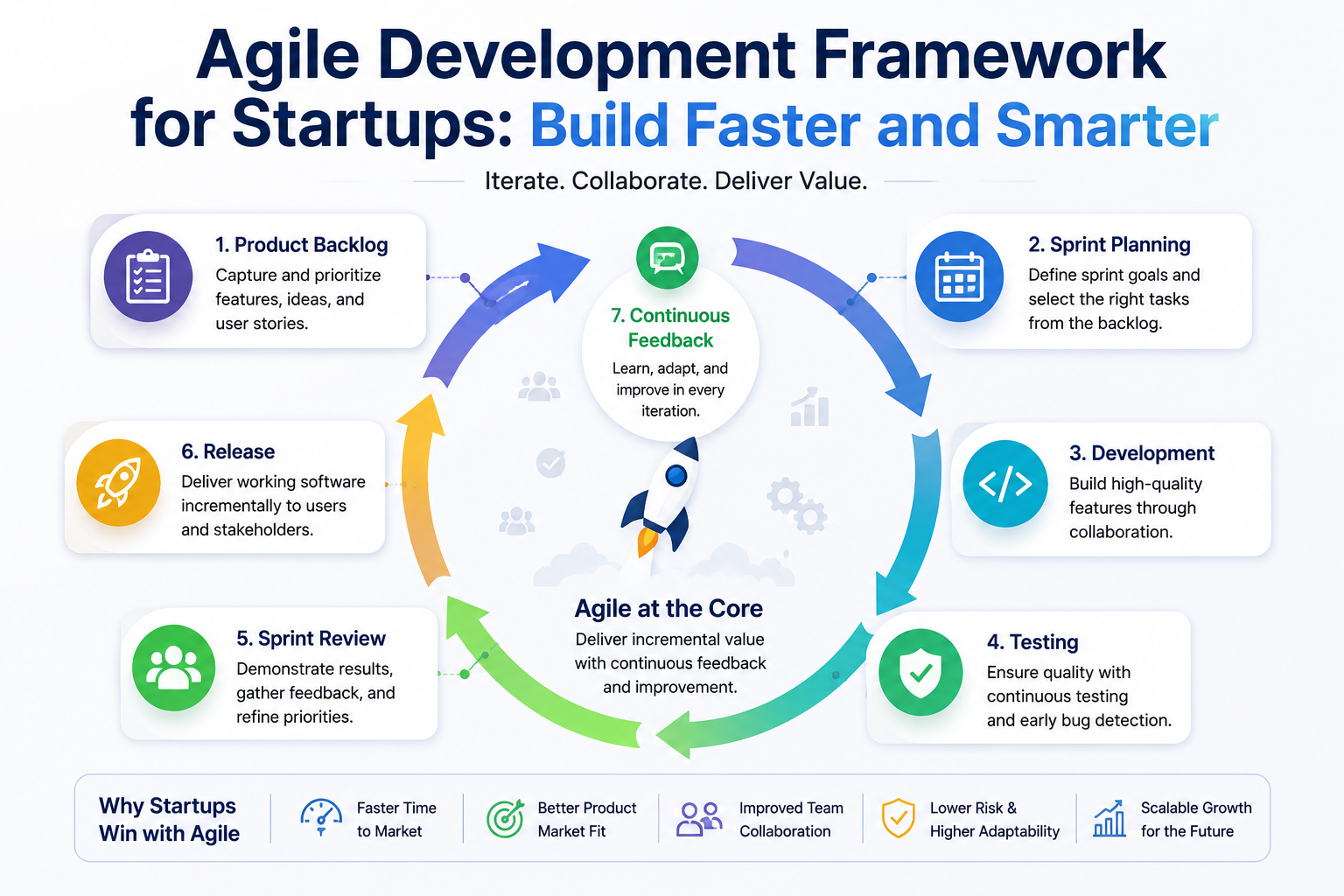
An Agile Development Framework is a structured approach to software delivery that emphasizes iterative development, continuous feedback, collaboration, and adaptability.
Instead of building an entire product before releasing it, Agile teams work in smaller development cycles known as sprints. Each sprint focuses on delivering working functionality that can be tested, reviewed, and improved based on stakeholder feedback.
Popular Agile frameworks include Scrum, Kanban, and hybrid Agile methodologies. While each approach differs slightly, they all share common principles:
- Customer-focused development
- Continuous improvement
- Transparent communication
- Incremental delivery
- Cross-functional collaboration
For startups, these principles create a foundation for sustainable growth and efficient product development.
Why Traditional Development Models Often Fail Startups
Many startups begin with a clear vision but struggle during execution.
A successful Agile Development Framework depends on more than sprint planning and task management. Visibility into project progress, priorities, and risks is equally important. That’s why many founders discover that transparency improves Agile software development by creating stronger collaboration and better decision-making throughout the product lifecycle.
Traditional software development processes typically follow a linear approach where requirements, design, development, testing, and deployment occur in separate phases. This can create several challenges:
Delayed Feedback
Teams may spend months building features before users ever see them. If assumptions are incorrect, significant time and resources are wasted.
Limited Flexibility
Startups operate in rapidly changing environments. Customer needs, market conditions, and business priorities can shift quickly. Traditional development models often struggle to accommodate these changes.
Reduced Visibility
Founders frequently lose visibility into project progress, making it difficult to identify risks or make strategic decisions.
This is one reason why transparency improves Agile software development by ensuring stakeholders remain informed throughout the entire development lifecycle.
Core Components of an Agile Development Framework
Successful Agile implementation requires more than daily standups and sprint planning. It depends on several key components working together.
Product Backlog Management
The product backlog serves as a prioritized list of features, improvements, bug fixes, and technical requirements.
Effective backlog management ensures development teams focus on the highest-value tasks first, maximizing return on investment and accelerating startup product development.
Sprint Planning
Sprint planning helps teams define objectives for a specific development cycle.
Clear sprint goals improve alignment between business stakeholders and developers while reducing confusion about priorities.
Daily Communication
Short daily meetings help teams discuss progress, identify blockers, and maintain momentum.
This continuous communication improves Agile project management and prevents small issues from becoming major obstacles.
Sprint Reviews
At the end of each sprint, teams review completed work and gather feedback from stakeholders.
This process allows startups to validate assumptions and make adjustments before investing additional resources.
Retrospectives
Retrospectives encourage continuous improvement by evaluating what worked well and identifying areas for optimization.
Teams that consistently review their processes often achieve better outcomes over time.
How Agile Accelerates Startup Product Development
Speed matters in competitive markets.
An Agile Development Framework helps startups move faster without compromising quality by enabling smaller, more manageable releases.
Faster MVP Launches
Rather than waiting months for a complete product, startups can launch a minimum viable product quickly and begin collecting real-world user feedback.
Better Product-Market Fit
Continuous feedback loops help founders understand customer needs and refine features accordingly.
Improved Resource Allocation
Agile helps teams prioritize work based on business value, ensuring development budgets are spent efficiently.
Reduced Risk
Frequent reviews and testing allow teams to identify issues early, reducing the likelihood of costly project failures.
Common Agile Mistakes Startups Should Avoid
While Agile offers significant advantages, poor implementation can limit its effectiveness.
Focusing on Tools Instead of Outcomes
Tools like Jira, Trello, and Linear support Agile processes, but they do not replace effective communication and strategic thinking.
Ignoring Stakeholder Feedback
Agile depends on continuous collaboration. Founders and stakeholders should remain actively involved throughout development.
Overloading Sprints
Attempting to deliver too much work within a sprint often results in missed deadlines and reduced quality.
Neglecting Technical Debt
Short-term development decisions can create long-term challenges.
Our guide on managing technical debt explores how startups can maintain development velocity while protecting future scalability.
The Role of Transparency in Agile Success
Transparency is one of the most important characteristics of a successful Agile Development Framework.
When stakeholders have access to project progress, sprint goals, roadmaps, and performance metrics, decision-making improves significantly.
Transparent teams are better equipped to:
- Identify risks early
- Align development with business objectives
- Build trust between stakeholders
- Improve collaboration
- Increase accountability
This is why many founders discover that transparency improves Agile software development far beyond simple status reporting.
Open communication transforms a development vendor into a strategic growth partner.
How Equal Efforts Technologies Uses Agile to Deliver Results
At Equal Efforts Technologies, we use an Agile Development Framework designed specifically for startup environments.
Our approach focuses on:
- Transparent communication
- Sprint-based delivery
- Continuous stakeholder involvement
- Data-driven decision making
- Scalable architecture planning
We believe startups deserve full visibility into every stage of development. By combining Agile best practices with strategic product thinking, we help founders launch faster, reduce risk, and build products that support long-term growth.
As products mature, businesses often need to scale from MVP to Series A while maintaining development quality and operational efficiency.
What is an Agile Development Framework?
An Agile Development Framework is a structured methodology that enables teams to deliver software through iterative development cycles, continuous feedback, and collaborative decision-making.
Why is Agile important for startups?
Agile helps startups adapt quickly to changing market conditions, launch products faster, and make informed decisions based on user feedback and business priorities.
Which Agile framework is best for startups?
Scrum is one of the most popular Agile frameworks for startups because it provides structure while maintaining flexibility. However, Kanban and hybrid approaches can also be effective depending on team size and project complexity.
How does Agile improve startup product development?
Agile improves startup product development by reducing risk, increasing visibility, accelerating feedback cycles, and ensuring resources are focused on the highest-priority initiatives.
What role does transparency play in Agile?
Transparency helps stakeholders understand project progress, identify challenges early, and maintain alignment between technical execution and business objectives.
Conclusion
An Agile Development Framework gives startups the structure they need without sacrificing flexibility. By combining iterative development, continuous feedback, transparent communication, and strategic planning, startups can reduce risk and accelerate product delivery.
The most successful startup teams understand that Agile is more than a methodology. It is a mindset that prioritizes collaboration, adaptability, and continuous improvement.
If you’re looking to build smarter, launch faster, and scale with confidence, adopting the right Agile Development Framework can provide the foundation for long-term success.
