


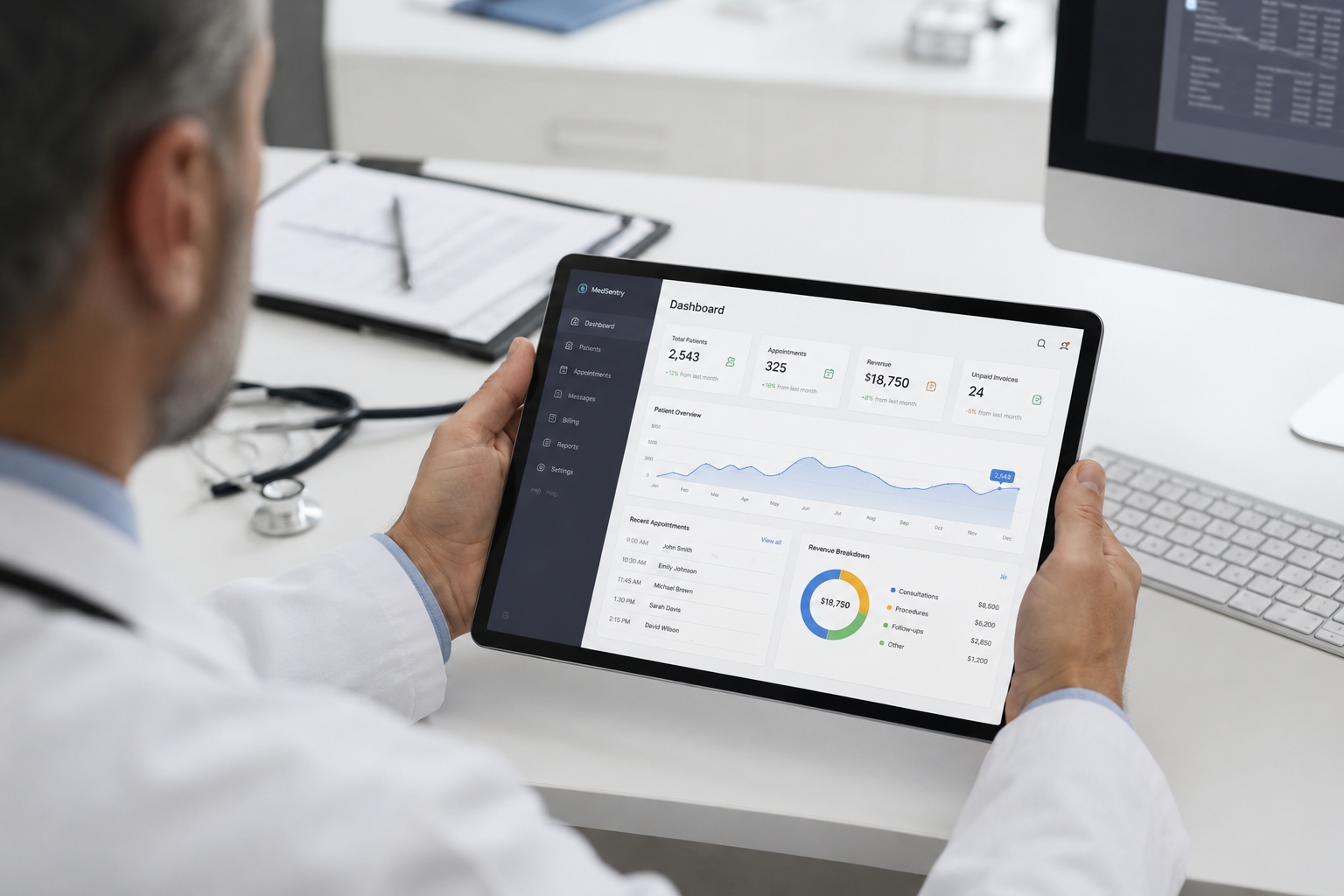
The Real ROI of Custom Web Portals: Efficiency Over Administrative Burden
In our experience working with clinics and hospital systems, we’ve found that the most successful healthcare software projects share a common philosophy: a portal should save staff time, not create more work. Too often, healthcare administrators approach healthcare digital transformation as a “check-the-box” exercise to satisfy regulatory requirements. They implement off-the-shelf patient portal software that feels like an afterthought, resulting in staff spending hours troubleshooting login issues or manually transcribing data. When analyzing the ROI of custom web portal development, we aren’t just talking about fancy features or interface design. We are talking about reclaiming thousands of hours of administrative time annually and redirecting that energy back into patient care.
The True Cost of “Out-of-the-Box” Solutions
Many healthcare providers default to standard portals provided by their EHR vendors. While these solutions are convenient to deploy, they are rarely optimized for the unique operational realities of a specific practice.
The Friction of One-Size-Fits-All
Generic software creates “process friction.” If your intake forms are rigid, your front-desk staff has to manually follow up with patients to complete missing fields. If the user interface is non-intuitive, your helpdesk phone lines light up with password-reset requests. These are not just minor inconveniences; they are cumulative costs that erode your bottom line.
Calculating Hidden Administrative Waste
When calculating the return on investment for new technology, administrators often look at the price of the software license. However, they frequently overlook the cost of labor.
If a portal requires even three extra minutes of staff intervention per patient, a practice seeing 50 patients a day loses 150 minutes of productivity. Over a year, that is hundreds of hours of labor costs spent on manual tasks that a well-architected custom solution could have automated from the start.

Strategic Advantages of Custom Web Portal Development
Investing in custom web portal development allows your organization to build tools that mirror your clinical workflows, rather than forcing your team to adapt to the limitations of a template.
Automation of Clinical Workflows
A custom portal can integrate directly with your existing backend systems to trigger clinical workflow automation, patient intake prompts, and insurance verification checks. By creating a seamless digital intake process, you eliminate the need for paper clipboards and manual data entry. Your staff becomes facilitators of care rather than data processors.
Improved Patient Adherence and Data Accuracy
Patient engagement is significantly higher when the digital experience is intuitive. Using tailored patient engagement solutions allows for personalized dashboards where patients can view their specific health history, lab results, and upcoming appointments. When patients feel empowered by their data, they are more likely to stay engaged, arrive prepared for appointments, and follow post-care instructions leading to better health outcomes and a more professional reputation for your facility.
Measuring ROI Beyond the Balance Sheet
Financial metrics are essential, but in healthcare, ROI is also measured in clinical quality and team retention.
Reducing Staff Burnout
Burnout is a critical issue in modern healthcare. Staff members who are bogged down by inefficient technology feel undervalued and frustrated. By providing your team with tools that actually work—systems that automate the mundane and highlight the important—you improve their daily experience. A well-designed portal is, in many ways, an investment in staff retention.
Scalability and Future-Proofing
Off-the-shelf software often leaves you beholden to a vendor’s roadmap. If they don’t prioritize a feature your clinic needs, you are out of luck. With custom healthcare application development, your software evolves alongside your practice. Whether you are expanding into telehealth, adding new departments, or integrating with wearable medical devices, your portal can be adapted to meet those needs as they arise, ensuring your investment remains relevant for years to come.
Choosing the Right Path for Your Organization
Transitioning to a custom solution is a significant step, but it is one that yields long-term dividends. It is about moving from “managing technology” to “leveraging technology.”
Assessing Your Current Tech Stack
Before beginning development, audit your existing systems. Identify the top three manual tasks that consume the most staff time. Are they appointment scheduling, form processing, or billing inquiries? A custom portal should address these specific pain points first.
Partnering for Success
The success of your portal depends on a development partner who understands healthcare compliance (such as HIPAA) and the nuances of clinical operations. At Equal Efforts Technologies, we don’t just write code; we analyze the workflows that drive your practice. We focus on building portals that remove administrative roadblocks, ensuring your technology is an asset that supports your mission of providing excellent patient care.
Conclusion
Ultimately, the true value of modernizing your digital ecosystem lies in balancing technological efficiency with the human element of care. Implementing an optimized strategy for custom web portal development protects your clinic from hidden resource leaks, alleviates daily administrative strain, and elevates the end-to-end user experience. If you want to see how this translates to real-world performance, read our complete case study on how we built a system that streamlined patient intake for a multi-specialty clinic. By prioritizing bespoke design over generalized templates, your healthcare enterprise transforms software from a costly friction point into a measurable engine of institutional growth.
Frequently Asked Questions (FAQ)
How long does custom web portal development usually take?
Development timelines vary based on the scope and complexity of the integration with your existing EHR. A phased approach, focusing on core functionalities like patient intake and appointment management first, often allows for a faster rollout and immediate ROI.
Is a custom portal HIPAA compliant?
Yes. When you choose an experienced development firm, HIPAA compliance is built into the architecture from day one. This includes data encryption, secure authentication, and rigorous auditing trails that are often more robust than what is provided in basic, generic software solutions.
How do I justify the upfront cost of a custom portal to stakeholders?
The business case is built on the reduction of administrative labor costs. By calculating the time saved on manual data entry, patient follow-ups, and helpdesk support, you can easily project a clear timeline for the software to pay for itself through increased operational efficiency.
